Moyra Stewart
Moyra has worked in clay for more than 45 years after graduating form Edinburgh College of Art in 1979. While living in Canada for 20 years she taught pottery and was involved in many community events and residencies. Returning to Scotland in 1999 she co-founded the Steeple Arts Co-op which in partnership with WASPS became the “The Steeple” studios and community arts facility in the old courthouse Newburgh, Fife.
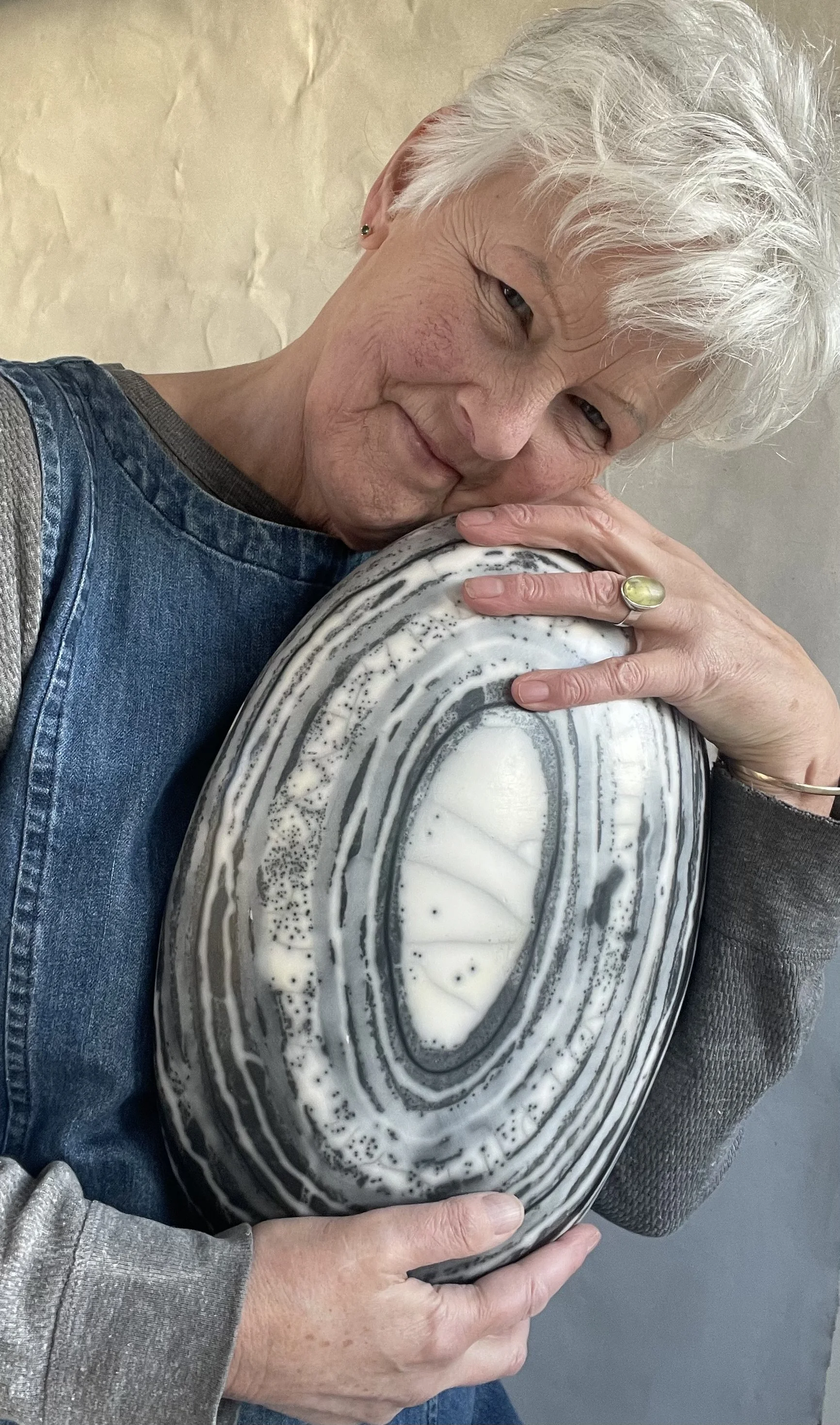
Primarily a handbuilder, Moyra also uses slab and pressmoulding techniques to make her ovalc sculptural vessels. She has perfected a multilayered Nake Raku technique that resembles Gneiss : an ancient rock found in the west coast of Scotland. the timeless solididty of these patterns seem more an integral part of the piece than just a decorative surface.
_____
My relationship with the natural world is a deeply felt enduring connection. Throughout my life I have found solace and comfort in wild places, retreating to forests, beaches and mountains when daily life becomes overwhelming. Along with a reliance on nature, I keep in mind that saying of Heraclitus “There is nothing permanent except change” to remind me not to cling onto anything too much. I do believe that the creative life is one of continual change and I try to embrace this in all aspects of my work and life.
I like to make soft clay look like stone that is billions of years old, the clay is fragile but looks hard and solid.The patterns might seem to indicate a rough surface but in fact it is unexpectedly smooth : I am interested in these contradictions. Indeed in all of my work I look to embrace the unexpected, to be open to change : to see it transform my work into something beyond the ordinary. I strive to make vessels that feel as though they are alive and vibrant, objects that resonate in the hand and the mind.
Naked Raku
in 2007 when I moved into my new studio at the Steeple I finally had the space to build a new raku kiln and start rakuing again.I had acieved lovely results with normal raku in Canada and was keen to start up again. however an initial experiment with resist slip had electrifying results and this new technique of Naked Raku intrigued me. Many many failures resulted in two years passing before I began to gain any consistency. however the stunning beauty of the successes kept me engrossed and I have been obsessed with this technique ever since. I went on to develop this process where I can achieve graduated tones that give a subtlety to the work that is totally unique. it is an insanely long and involved process and the nature of Raku means that there are inevitably many failures. But the successes have a vibrancy and tactile quality that is gorgeous, and uniquely original.
My Process
In naked raku a layer of liquid clay slip is applied under the glaze, allowing the glaze to mask the smoke and then come off after cooling. in my process I use thick slip to create patterns on the piece, then pour a layer of thin slip over the whole thing. This is followed by a layer of thin glaze and then thick glaze is piped on to follow the original patterns. after all these layers have dried I take a toothpick and carve a line that follows the patterns. this line incises down to the clay surface and will be a black line after smoking. once all this is done I fire in small batches in the raku kiln outside. After the work cools, all the layers are rubbed off with cloths and lots of water, finally when the piece has been rubbed clean it must be left to dry. This in itself is quite a task as the glaze has melted and the slip has been hardened by the firing. finally when the piece has been rubbed clean it must be left to dry.

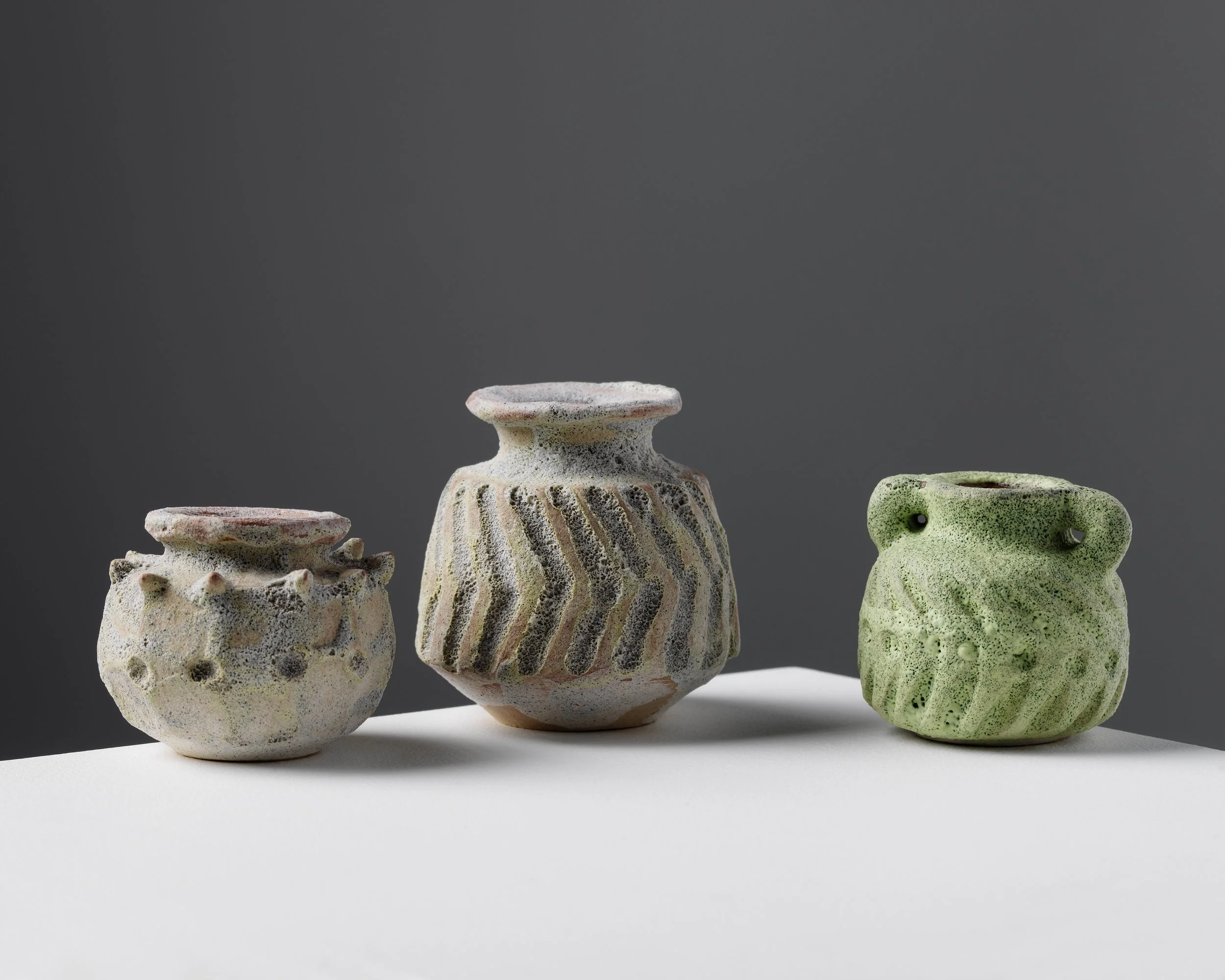
New Work
For the last ten years I have been experimenting with different techniques to make high fired pebbles and boulders. None of these came even close to the naked raku pebbles - until last year. The first successful high fired pebble came about through layering of lava and plain glazes to create a surface that looks and feels like a real stone. This extensive testing of lava glazes has also inspired me to make some high fired vases and some very small thrown pots. I am fascinated by the rough texture that makes these vessels seem as though they have lain in the earth or under the sea for centuries.